A smarter model makes your agent more confidently wrong
The dominant agent failure mode in 2026 isn't the model — it's context debt. And a frontier model doesn't pay it down. It hides it.
Upgrade the model. That’s the reflex when an agent gives a wrong answer in production. A new release drops, you change the model string, the demo looks sharper, everyone moves on to the next ticket.
It’s the wrong lever. And on a frontier model, pulling it makes the failure harder to catch, not easier.
The gap isn’t where you think it is
A few years ago, most agent failures were model failures. The model wasn’t capable enough, full stop. That gap has closed. The frontier models everyone’s shipping on can reason, plan, and call tools fluently enough that raw capability is rarely the thing breaking your system.
What breaks it now is context. The wrong documents got retrieved. The memory is stale. A tool returned nothing and nobody handled it. The instructions contradicted themselves fifteen turns into a session. The model was fine — it just acted on a bad picture of the world.
Call it context debt: the gap between what your agent needs to know at a given step and what you actually put in its window. Like any debt, it’s invisible until it’s called in. And the interest compounds in a way most teams never see coming.
The confidence inversion
Here’s the part that catches people.
A weaker model running on incomplete context produces obvious garbage. The answer is incoherent, the reasoning is visibly broken, and it gets caught in review in about four seconds. The bad context is still there — but the weak model is doing you a favor by failing loudly.
Put a frontier model on that same incomplete context and you get something coherent, well-structured, and confidently wrong. It reads like a careful senior engineer wrote it. Every sentence is plausible. The citation looks real. And it sails straight through review, because nothing about it looks like an error.
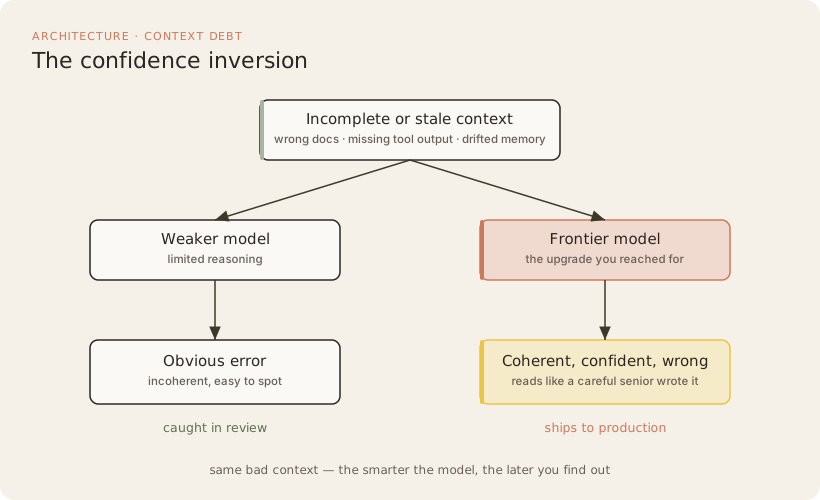
So the upgrade didn’t fix the context problem. It raised the stakes of it. You made your failures more expensive to detect, and you spent budget feeling like you’d solved something.
A stronger model doesn’t remove the error. It removes the tell.
That’s the inversion: the better the model, the later you find out it was wrong, and the more it costs when you do.
Where the debt actually accumulates
I ran a head-to-head retrieval evaluation once on a set of 300-page compliance documents — standard chunked retrieval against a more structure-aware approach. Same model on both sides. The thing that decided output quality wasn’t the model at all. It was whether retrieval surfaced the governing clause or a plausible-looking neighbor two pages away. One strategy grounded the answer. The other produced a citation that looked perfect and pointed at the wrong rule.
The model never knew the difference. It can’t. It reasons over whatever you hand it.
A few places the debt piles up:
- Similarity-only retrieval. Semantically close isn’t relevant. A document about “regulatory compliance risk” looks similar to a query about “audit exposure” and answers neither. Cosine similarity is not comprehension.
- Stale memory. Context that was true forty turns ago and quietly isn’t anymore.
- Unbounded scope. Give an agent access to everything and it pulls in noise it can’t distinguish from signal.
- Silent tool failures. A tool returns malformed output, the agent doesn’t catch it, and reasons confidently across the gap.
None of these improve when you swap the model. Some get worse — a stronger model is just better at making the gap invisible.
What I’d build instead
The lever that actually moves the failure rate is the context layer. The unglamorous discipline is treating it as an engineering problem, not a search problem.
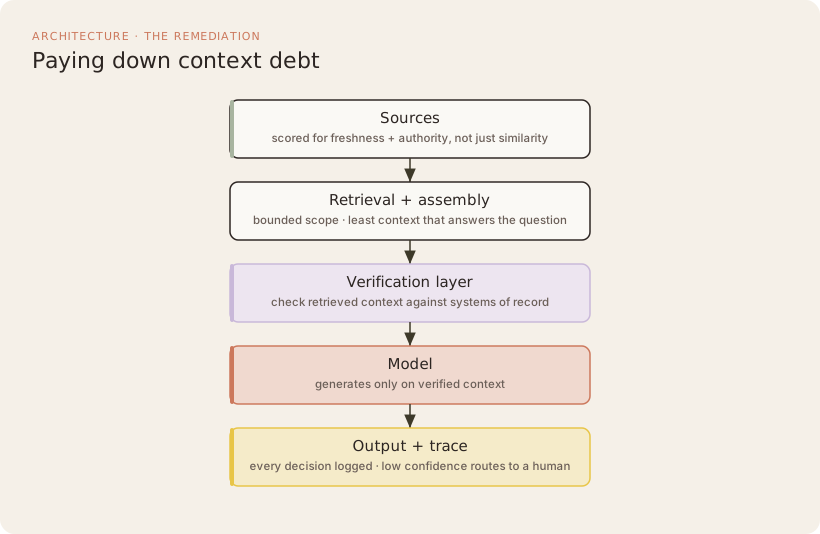
Concretely, that’s four moves. Score sources on freshness and authority, not just vector similarity. Bound the agent’s scope to the least context that answers the question, and let it refuse anything outside that boundary. Put a verification layer between retrieval and generation that checks retrieved context against a system of record before the model ever sees it. And trace every decision, with low-confidence answers routed to a human instead of shipped.
The trade-off, named
This isn’t free, and pretending it is would be the kind of thing I’m arguing against.
A verification layer adds latency and cost — you’re spending tokens and milliseconds to check work before generation. You give up the seductive simplicity of “change the string, ship the release.” Bounding scope means your agent will decline things it could plausibly attempt, which looks worse in a demo and is better in production.
I’ll take that trade every time. A slower agent that’s wrong in ways I can see beats a fast one that’s wrong in ways only a domain expert catches three weeks later, after it’s quietly shaped a decision nobody traced.
The hard part of agents was never the model. It’s the discipline to engineer what the model knows at the exact moment it acts. The teams shipping reliable agents in 2026 aren’t running smarter models than you. They’re running better context.
So before you reach for the next release, ask the only question that matters: would a smarter model fix this — or just hide it better?